Report on the event
Hungary in Europe
Between integration and independence
1. Open General Meeting of the OWWF Bayern
First, a short open general meeting was held. In his brief report on his 12 years in office, outgoing President Eberhard Sinner highlighted key milestones, including the Peace Chapel in Rossoschka, initiated by the OWWF, and the first events with India. This was followed by the election of the new Presidium and Executive Board.
The new president of OWWF Bavaria is Minister of State Eric Beißwenger, while Hermann Pönisch remains in office as vice-president. The other members of the Presidium and Executive Board can be found on our homepage. Former Minister of State Eberhard Sinner was appointed Honorary President to loud applause.
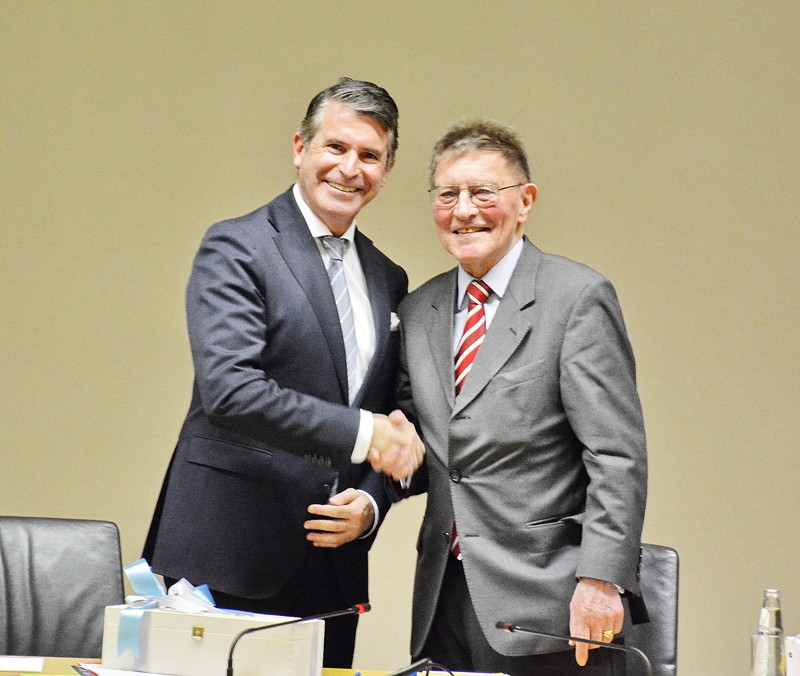
Handover: Eberhard Sinner congratulates Minister of State Beißwenger on his election as president of OWWF
2. Official event section "Hungary in Europe"
The event was prepared in cooperation with the Bavarian-Hungarian Forum. Two speakers with Hungarian-German roots were invited to present their different points of view.
Daniel Hegedüs, Deputy Director of the Institute for European Politics in Berlin. He studied political science at Humboldt University, among other places. His areas of expertise include autocratisation, setbacks in the rule of law, the European Union, Central Europe, foreign policy, measuring democracy, promoting democracy and supporting civil society. He has over 15 years of experience in research, advocacy, project management and consulting for the private and public sectors.
His lecture is entitled "The Counter-Model"
Autocratisation, Strategic Corruption and Multivectoral Foreign Policy:
Hungary's Model Challenge for the EU under Viktor Orbán
Using freely available data (OSCE, EU, etc.), Hegedüs showed how Orbán's Hungary is increasingly moving from liberal democracy to autocracy. Diversity of opinion and thus freedom of expression are being restricted, and the rule of law is being dismantled. He substantiates his point of view with examples on the following points:
Erosion of the horizontal separation of powers
Limited media pluralismRestriction of civil and human rights
Electoral regime – free but not fair elections
Strategic corruption: Hungary ranks last in the EU in terms of financial irregularities
Foreign policy model of "geopolitical disloyalty"
His conclusion: the Hungarian model of autocratisation has turned Hungary into a free rider within the EU, threatening the democratic integrity of the European Union and at the same time calling into question its unity on geopolitical and security issues.
Click here to view the presentation with numerous statistics that support his point of view.
(For technical reasons, the presentation could not be shown during the event.)
The counterpoint was provided by Bence Bauer, Director of the Mathias Corvinus Collegium, Budapest.
As the quotes from the magazines listed on the homepage show (e.g. Cicero, Exxpress, Praußische Allgemeine, Die Tagespost, which are generally attributed to the right-wing populist and, in some cases, neo-right-wing scene), Bauer presented himself as a defender of current Hungarian domestic and foreign policy (position paper).
In his speech, Bauer examines the tensions between European integration and national sovereignty using Hungary as an example. He emphasises that criticism of Hungary's policies – such as its electoral system or the rule of law – is often politically motivated, while the country itself considers its system to be democratically legitimate. The high turnout in European elections refutes the image of Hungary as anti-European; differences with the EU reflect different political priorities.
Under Prime Minister Viktor Orbán, Hungary pursues a strategically independent, dialogue-oriented foreign policy and seeks exchange with global actors. Conflicts with the EU arise over border protection, financial sanctions and the withdrawal of Erasmus funds, which Budapest perceives as an imbalance. Individual legal cases also fuel the impression of double standards.
Overall, his presentation aims to show Hungary as a committed EU member that emphasises national scope for action. The central question remains how much independence the European Union can allow – a balancing act that requires composure and critical self-examination.
The subsequent discussion was quite controversial, at times very emotional, with populist views being expressed.
Afterword by the author Hermann Pönisch: the current attitude of contempt towards Ukrainian victims and the Fidesz party's anti-EU election campaign do not necessarily demonstrate respect for the European values of humanity, the rule of law and solidarity. It is therefore not surprising that comments in the German press also consider Hungary's exclusion from the EU to be worth considering.
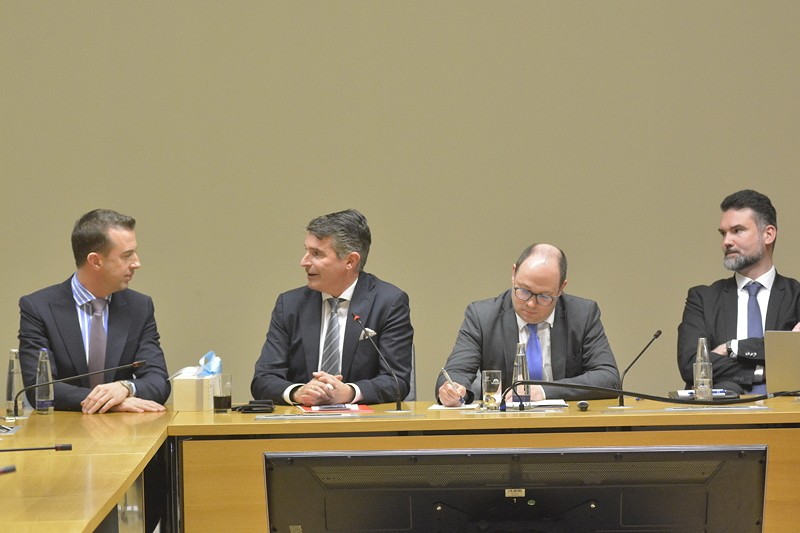
From left: Consul General G. Tordai-Lejkó, Minister of State Beißwenger, speakers: B. Bauer, D. Hegedüs